Thursday, 22 December 2022

William James on choosing purpose over profit and the life changing power of a great mentor

 William James (January 11, 1842–August 26, 1910) is celebrated as one of the most influential philosophers of all time. His publication of The Principles of Psychology in 1890 established him as the father of American psychology. His 1901 treatise The Varieties of Religious Experience: A Study in Human Nature, originally delivered at the prestigious Gifford Lectures, remains one of the most important theological works of all time and inspired Carl Sagan’s superb The Varieties of Scientific Experience. But if James were alive today, his contributions might well be dismissed under the fashionable accusation of privilege — he was born into a wealthy family and his father, a prominent theologian, was independently wealthy himself a century and a half before the term “independently wealthy” entered the vernacular; his godfather was Ralph Waldo Emerson. But he also endured an undue share of physical hardship, suffering from a range of physical ailments since childhood — near-blindness, debilitating back pain, and various skin and stomach conditions — as well as regular bouts of severe, suicidal depression since early adulthood. His life was defined by dualities in deeper ways, too — James was a man straddling two epochs as a scholar of theology in an era when the dogmatic beliefs of the previous generation where past the point of repair and a science-minded skeptic before the golden age of twentieth-century scientific discovery.

And yet despite these vexing dualities, James navigated his life with tremendous faith in the power of personal choice in shaping one’s destiny — which included, as it always has and always will, the discomfiting luxury of making difficult decisions. Nearly four decades before he came to put this conviction into words in his timeless treatise on habit — “We are spinning our own fates, good or evil, and never to be undone.” — he enacted it in his own life as he stood on the precipice of a monumental choice, the kind all of us have to make at one point or another, the value of which we only ever appreciate in hindsight.

In 1861, 19-year-old William enrolled into Harvard to study science after a short apprenticeship with the artist William Morris Hunt. But as he immersed himself in the pursuit of a medical degree, he grew increasingly disillusioned with the prospects laid before him by this established path to a “successful” life as a respectable doctor — a life of steady income and steady petrification of his deeper aspirations. He knew he had to confront the trying choice between profit and purpose. (Around the same time, halfway around the world, a young Leo Tolstoy was tussling with a parallel tension between income and ideals.)

In a letter to his cousin Kitty from September of 1863, found in the altogether illuminating The Letters of William James, Vol. 1 (public libraryfree download), 21-year-old James outlines his choices with equal parts exasperation and snark:

I have four alternatives: Natural History, Medicine, Printing, Beggary… After all, the great problem of life seems to be how to keep body and soul together, and I have to consider lucre. To study natural science, I know I should like, but the prospect of supporting a family on $600 a year is not one of those rosy dreams of the future with which the young are said to be haunted. Medicine would pay, and I should still be dealing with subjects which interest me — but how much drudgery and of what an unpleasant kind is there!

He adds a lament about the crippling industrial model of higher education, which shoves young people down the conveyer belt of specialization and careerism before they’ve had a chance to find their true purpose — a lament equally, if not more, valid today:

The worst of this matter is that everyone must more or less act with insufficient knowledge — “go it blind,” as they say. Few can afford the time to try what suits them.

In a letter to his mother later that month, James exorcizes the growing urgency and unease of his impending choice:

I feel very much the importance of making soon a final choice of my business in life. I stand now at the place where the road forks. One branch leads to material comfort, the flesh-pots; but it seems a kind of selling of one’s soul. The other to mental dignity and independence; combined, however, with physical penury.

James, longing to be a family man, peers into the future and considers how choosing the pursuit of purpose over profit would affect his imaginary future love, to whom he refers by a Shakespearean allusion, as he revisits his four options:

If I myself were the only one concerned I should not hesitate an instant in my choice. But it seems hard on Mrs. W. J., “that not impossible she,” to ask her to share an empty purse and a cold hearth. On one side is science, upon the other business (the honorable, honored and productive business of printing seems most attractive), with medicine, which partakes of the advantages of both, between them, but which has drawbacks of its own. I confess I hesitate. I fancy there is a fond maternal cowardice which would make you and every other mother contemplate with complacency the worldly fatness of a son, even if obtained by some sacrifice of his “higher nature.” But I fear there might be some anguish in looking back from the pinnacle of prosperity (necessarily reached, if not by eating dirt, at least by renouncing some divine ambrosia) over the life you might have led in the pure pursuit of truth. It seems as if one could not afford to give that up for any bribe, however great.

And yet, admitting to being “undecided” still, James is aware of the rare privilege that renders him among those few young people who “can afford the time to try what suits them.” He tells his mother with a self-conscious wink:

I want you to become familiar with the notion that I may stick to science, however, and drain away at your property for a few years more.

James did choose to stick to science. Around the time he wrote that letter to his mother, he changed majors from Chemistry to Comparative Anatomy and Physiology — the Harvard department where he lucked into one of the most formative relationships of his life. There, he came to study under a professor named Jeffries Wyman, whose influence on James’s ideals and decisions became a spectacular testament to how unsung mentors and champions shape creative geniuses. A brilliant yet humble man — a perennially rare combination — he imparted on his pupils, by way of personal example, enduring values of kindness, generosity, humility, unflinching integrity, and resolute refusal to advance himself at anyone else’s expense. Under Wyman’s wing during those two critical years of determining the course of his entire life, James blossomed into himself — his ideals, his values, his character — with courageous authenticity. He would later come to write of his mentor:

His extraordinary effect on all who knew him is to be accounted for by the one word, character. Never was a man so absolutely without detractors. The quality which every one first thinks of in him is his extraordinary modesty, of which his unfailing geniality and serviceableness, his readiness to confer with and listen to younger men… Next were his integrity, and his complete and simple devotion to objective truth. These qualities were what gave him such incomparable fairness of judgment in both scientific and worldly matters… He had if anything too little of the ego in his composition, and all his faults were excesses of virtue. A little more restlessness of ambition, and a little more willingness to use other people for his purposes, would easily have made him more abundantly productive, and would have greatly increased the sphere of his effectiveness and fame. But his example on us younger men, who had the never-to-be-forgotten advantage of working by his side, would then have been, if not less potent, at least different from what we now remember it; and we prefer to think of him forever as the paragon that he was of goodness, disinterestedness, and single-minded love of the truth.

James graduated from Harvard with a degree in medicine, but wasn’t interested in practicing. Instead, he followed his calling and set out to study philosophy and psychology on his own, imbibing self-education with diligent visits to the Harvard and Boston libraries. He persevered through failing eyesight, debilitating depression, and frequent brushes with the very “beggary” he foresaw and feared. Decades later, having followed his purpose to become America’s first great psychologist, he joked: “I never had any philosophic instruction, the first lecture on psychology I ever heard being the first I ever gave.”

The Letters of William James is full of soul-stretching insight into one of the greatest minds and most visionary spirits humanity has ever known, featuring James’s meditations on melancholy, happiness, writing, creativity, and human nature. His brother, the great novelist Henry James, captures this beautifully in the introduction to the 1920 edition:

Life spoke to him in even more ways than to most men, and he responded to its superabundant confusion with passion and insatiable curiosity. His spiritual development was a matter of intense personal experience.

Complement this particular snippet with a recentering read on how to find your purpose, then revisit Alan Watts on money vs. wealth and Eleanor Roosevelt on living with integrity. Also a soon to be launched, podcast on the same issues by my mentor. ( Surprise !! ) 

Thursday, 24 November 2022

Dostoyevsky in Love

Weddings and more remind me of Fyodor Dostoyevsky (November 11, 1821–February 9, 1881) who was twenty-seven when he was arrested for belonging to a literary society deemed dangerous by the tsarist regime and sentenced to death. His sentence was repealed at the last moment, prompting him to pen an ecstatic letter about the meaning of life that evening. But he was not set free — instead, he served four years in a hard labor camp in Siberia. 

Upon his release, the thirty-three-year-old Fyodor remained in Siberia, destitute and directionless, trying to restart his life. He befriended a Russian expatiate working as a minor local official — a painful alcoholic who was nonetheless “an intelligent, educated, and good man,” and whom he came to love as a brother. He had a wife, Maria, and a seven-year-old son. They welcomed him into their home as part of the family while he struggled to find his footing. Maria took a lively interest in his conversation and a great pity in his fate, this young and desperate man heavy with unhappiness and savaged by epilepsy. 

By the following spring, ready to reenter the world and find a means of subsistence, he joined the Siberian Army Corps as a soldier. Leaving the family, he found parting with them harder “than parting with life.”

But as soon as he left, his friend’s alcoholism finally caught up with him and felled him. Suddenly widowed and with no means of providing for her son, Maria plummeted into the depths of despair — in her time and place, a woman with no husband and no property was, as Mary Shelley put it in the same epoch, “the world’s victim.” Fyodor was moved to see “with what selflessness, with what strength” Maria bore her misfortune. Dangerously in debt himself, he borrowed some money and immediately sent it to her, then spent months petitioning to get her son admitted into a good school. 

What he dared not tell her was that he was deeply in love with her. But Maria — a woman of bright intelligence and passionate curiosity — had already guessed it. 

Portrait of Fyodor Dostoyevsky by Vasily Perov, 1871

They remained in weekly correspondence. A hope swelled in his heart that he might have his chance at hers. 

It came as a shock when, a year later after her husband’s death, Maria announced that she was to marry a Siberian schoolteacher five years her junior, poor and uneducated. Immediately, Fyodor cobbled together some money to make the 1,700-mile journey across the tundra to see her. He recounted what happened in an electric letter to his closest friend, writing the summer before his thirty-fifth birthday:

I saw her! What a noble, what an angelic soul! She cried, and kissed my hands, but she loves another. I spent two days here. In those two days she remembered the past and her heart was again turned towards me.

He was unsure whether he could trust what he felt to be true, but when she beckoned him not to be sad, not to cry, because “not everything is decided yet,” he clung to her words like a drowning man. For two days, he was plunged into “unbearable bliss and torment.” He left with “complete hope.”

But by the time he arrived home, a letter awaited him. Maria loved the other man more than him. He was crushed. “I don’t know what will will become of me without her,” he told his friend, then added: “I am done for, but she is too.”

Mixing a jilted lover’s sorrowful unreason with reasonable concerns, he worried that the young schoolteacher was unsuited for Maria, intellectually and spiritually, and unable to provide for her and her son. He wrote to his friend:

She is 29 years old; she is educated, a bright girl who has seen the world, knows people, has suffered, has been tormented, ill from the last years of her life in Siberia, who is searching for happiness, is self-willed, strong, she is now ready to marry a 24-year-old youth, a Siberian who hasn’t seen anything, doesn’t know anything, who is barely educated, who is beginning the first idea of his life… without significance, without a place in the world, with nothing, a teacher in a provincial school… Who knows how far the discord, which I unavoidably foresee in the future, will go; for even if he were an ideal youth, he’s nevertheless not a strong person. And he’s not only not ideal, but… Anything might happen later on.

He proceeded to catastrophize with a panoply of possible hurts the young man could inflict on Maria’s way. “My God — my heart is breaking,” he wailed on the page, extolling her worthiness to his friend, intimating the other man’s unworthiness of her:

If you knew what an angel she is… every minute something original, sensible, witty, but paradoxically too, infinitely good, truly noble — she has a chivalrous heart: she will do herself in.

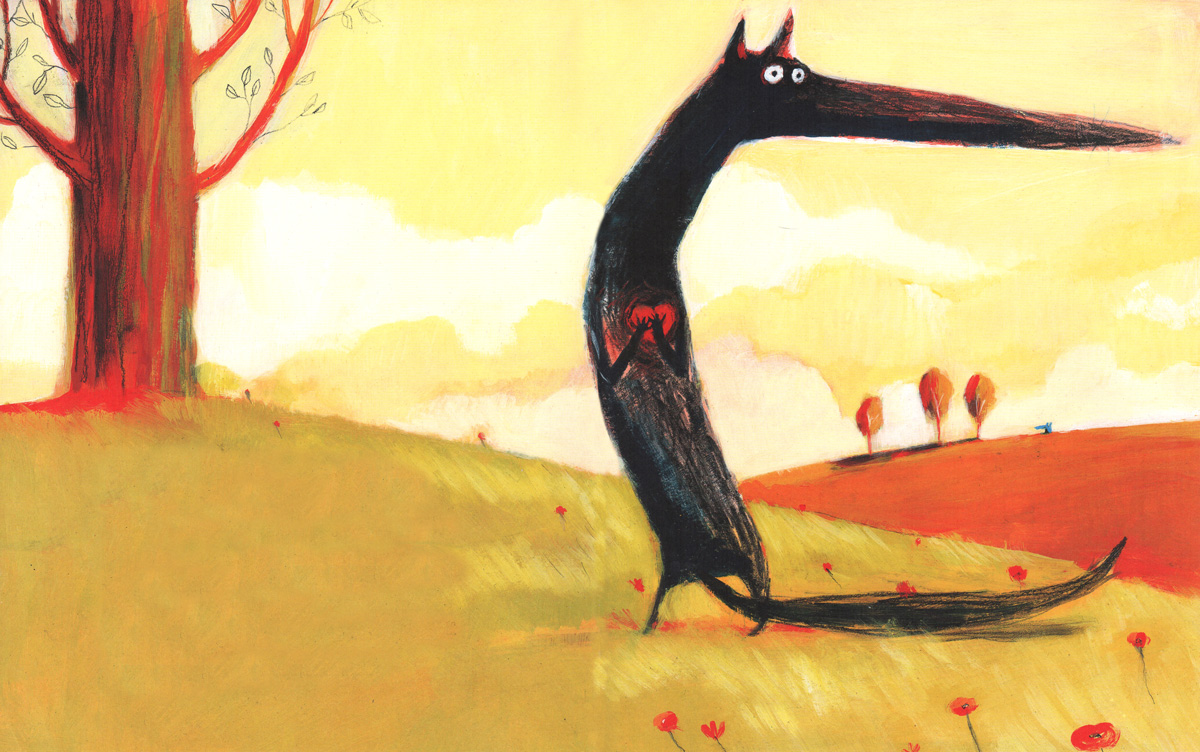
Art by Olivier Tallec from Big Wolf & Little Wolf

But then, in an act of extraordinary moral grandeur — “I love her happiness more than my own,” he wrote — he asked his friend, who was also his sometime-patron and a man of influence, to intercede on the young schoolteacher’s behalf and push forward his application for a raise that would double his salary. “She must not suffer. If she marries him, then let there be at least some money.” Later, Dostoyevsky would transmute this gesture into a story-line in his 1861 novel The Insulted and the Injured. “This is all for her, for her alone. If only so that she wouldn’t be impoverished,” he told his friend. 

Despite being deeply in debt himself, he kept cobbling together funds to go visit Maria, hoping she would change her mind. The long journeys worsened his epileptic attacks, which leveled him bodily and mentally, leaving him in “despondency and a state of psychic abasement.” 

The seasons turned, but his resolve was only growing stronger. On the cusp of winter, living up to the drama of the nineteenth-century Russians, he was writing to his friend again:

I love her madly, more than before. My longing for her would have driven me to my grave and literallyreduced me to suicide, if I hadn’t seen her… I know that I’m acting imprudently in many ways in my relations with her, since I have almost no hope — but whether there’s hope or not — it’s all the same to me. I don’t think about anything else. If only I could see her, hear her! I’m an unfortunate madman!

And then, with helpless self-awareness, he added:

Love in such a guise is an illness. I sense that.

Lone Man by Rockwell Kent, 1919. (Available as a print and as stationery cards.)

Throughout his courtship, Fyodor had been troubled by one glaring gap in his reasoning. A decent man, a practical man, he was aware that he too had no way of providing for Maria and her son on his meager soldier’s salary — if she married him instead of the young schoolteacher, she would still suffer the privations of poverty. But then, in the final weeks of 1856, everything changed: He was promoted to officer and, immediately, he made a formal proposal. Just before the Christmas holidays, after keeping the entire tortuous story of the romance from his family, he finally wrote to his sister:

I’ve loved this woman for a long time, insanely, more than my own life. If you knew her, this angel, then you wouldn’t be surprised. She has so many wonderful, excellent qualities. She is intelligent, sweet, educated, as women rarely are, with a meek character… My friend, dear sister! Don’t object, don’t be sad, don’t worry about me. I couldn’t have done anything better. We make a good couple… We understand each other, we are of the same inclinations, rules. We have been friends for a very long time. We respect each other, I love her.

Maria said “yes.” 

Art by Sophie Blackall from Things to Look Forward to

Fyodor wrote to his friend, in whom he had first confided of his love:

I am getting married… Nobody but this woman will be able to make me happy. She still loves me… She loves me. That I know for certain. I knew it then, too, when I wrote my letter to you last summer. She soon lost faith in her new attachment… Oh, if only you knew what this woman is!

They were married on February 7, 1857, and remained together until her untimely death of tuberculosis seven years later. Under the auspices of Maria’s love, Fyodor Dostoyevsky became the eternal voice singing in the cathedral of literature.

Wednesday, 23 November 2022

Relationship Rupture and the Limbic System: The Physiology of Abandonment and Separation

 We can count on so few people to go that hard way with us,” Adrienne Rich wrote in framing her superb definition of honorable human relationships. It is a cruelty of life that, along the way, people who once appeared fitted to the task crumble in character when the going gets hard in that natural way hardship has of visiting all human lives. 

When relationships collapse under the weight of life, the crash is not merely psychological but physiological — something less and less surprising as we learn more and more about consciousness as a full-body phenomenon beyond the brain. A quarter century ago, the pioneering immunologist Esther Sternberg began demonstrating how relationships affect our immune system. But there is no system they impact more profoundly than the limbic: our neurophysiological command center of emotion — something psychiatrists Thomas Lewis, Fari Amini, and Richard Lannon explore throughout their revelatory book A General Theory of Love (public library), which also gave us their insight into music, the neural harmonics of emotion, and how love recomposes the brain.

Art by Maurice Sendak from a vintage children’s book by Janice May Urdy.

The profound disruption of relationship rupture, they observe, is related to our earliest attachments and the way our system processes separation from our primary caregivers — a primal response not singular to the human animal:

Take a puppy away from his mother, place him alone in a wicker pen, and you will witness the universal mammalian reaction to the rupture of an attachment bond — a reflection of the limbic architecture mammals share. Short separations provoke an acute response known as protest, while prolonged separations yield the physiologic state of despair

A lone puppy first enters the protest phase. He paces tirelessly, scanning his surroundings from all vantage points, barking, scratching vainly at the floor. He makes energetic and abortive attempts at scaling the walls of his prison, tumbling into a heap with each failure. He lets out a piteous whine, high-pitched and grating. Every aspect of his behavior broadcasts his distress, the same discomfort that all social mammals show when deprived of those to whom they are attached. Even young rats evidence protest: when their mother is absent they emit nonstop ultrasonic cries, a plaintive chorus inaudible to our dull ape ears.

Behaviorally and psychologically, the despair phase begins when fretfulness, which can manifest as anxiety in humans, collapses into lethargy — a condition that often accompanies depression. But abrupt and prolonged separation produces something much more than psychological havoc — it unleashes a full-system somatic shock. Various studies have demonstrated that cardiovascular function, hormone levels, and immune response are all disrupted. Thomas Lewis, Fari Amini, and Richard Lannon capture the result unambiguously:

Relationship rupture is a severe bodily strain… Prolonged separation affects more than feelings. A number of somatic parameters go haywire in despair. Because separation deranges the body, losing relationships can cause physical illness.

But harrowing as this reality of intimacy and its ruptures may be, it also intimates something wonderfully assuring in its mirror-image — just like painful relationships can so dysregulate us, healthy relationships can regulate us and recalibrate our limbic system, forged in our earliest attachments.

The solution to the eternal riddle of trust emerges as both banal and profound — simply the practice of continually refining our discernment about character and cultivating intimate relationships of the kind life’s hard edges cannot rupture, with people who are the human equivalent not of poison but of medicine, and endeavoring to become such people ourselves for the emotional ecosystems of those we love. 

Thomas Lewis, Fari Amini, and Richard Lannon write:

A relationship is a physiologic process, as real and as potent as any pill or surgical procedure.

[…]

Total self-sufficiency turns out to be a daydream whose bubble is burst by the sharp edge of the limbic brain. Stability means finding people who regulate you well and staying near them.

This might sound simple, almost simplistic, but it is one of the most difficult and redemptive arts of living — for, lest we forget, “who we are and who we become depends, in part, on whom we love.”

Complement with Alain de Botton on the psychological Möbius strip that keeps us in unhealthy relationships (and how to break it) and David Whyte on the deeper meanings of friendship, love, and heartbreak, then revisit Hannah Arendt on what forgiveness really means.

Tuesday, 22 November 2022

The Art of Receiving: John Steinbeck on the True Meaning of Gratitude

 “It’s only when we demand that we are hurt,” Henry Miller observed when he weighed the delicate balance of giving and receiving. A demand is a metastasis of longing. Because longing is the defining feature of human life, learning to bear our longing without demanding is the beginning of healing. 

Nothing is more salutary to the soul than that which comes unbidden and is received freely. And yet, paradoxically enough, it is in receiving that we most often trip up — for to receive is an act of tremendous trust and tremendous vulnerability. True gratitude has as its object not what is given but what is received. The art of receiving is therefore the precursor to any sense of gratitude — our deepest wellspring of thanks-giving. 

That is what John Steinbeck (February 27, 1902–December 20, 1968) explores in one of the myriad dazzling passages that strew The Log from the Sea of Cortez (public library) — his uncommonly insightful meditation on how to think better and see the pattern beneath the particulars.

John Steinbeck

With an eye to a friend so skillful at receiving that “everyone felt good” in giving to him — “a present, a thought, anything” — Steinbeck writes:

Perhaps the most overrated virtue in our list of shoddy virtues is that of giving. Giving builds up the ego of the giver, makes him superior and higher and larger than the receiver. Nearly always, giving is a selfish pleasure, and in many cases it is a downright destructive and evil thing. One has only to remember some of our wolfish financiers who spend two-thirds of their lives clawing fortunes out of the guts of society and the latter third pushing it back. It is not enough to suppose that their philanthropy is a kind of frightened restitution, or that their natures change when they have enough. Such a nature never has enough and natures do not change that readily. I think that the impulse is the same in both cases. For giving can bring the same sense of superiority as getting does, and philanthropy may be another kind of spiritual avarice.

It is a countercultural notion, this indictment of the greed of generosity, especially in our culture of virtue-signaling and performative giving. But only by acknowledging this particular form of selfing can we begin to appreciate the beauty of its mirror-image in the art of receiving — an art truer and more tender, for it requires not an exercise of the ego but its exorcism. 

Art by Jacqueline Ayer from The Paper-Flower Tree

Steinbeck writes: 

It is so easy to give, so exquisitely rewarding. Receiving, on the other hand, if it be well done, requires a fine balance of self-knowledge and kindness. It requires humility and tact and great understanding of relationships. In receiving you cannot appear, even to yourself, better or stronger or wiser than the giver, although you must be wiser to do it well. 

It requires a self-esteem to receive — not self-love but just a pleasant acquaintance and liking for oneself.

The Log from the Sea of Cortez remains one of the finest things I have ever read. Complement this fragment with Seneca on gratitude and what it really means to be a generous human being, then revisit Steinbeck on love, the necessary contradictions of human nature, the difficult art of the friend breakup, and his Nobel Prize acceptance speech about what it means to be a writer.

Monday, 21 November 2022

3 Things to Learn from a Child, 7 from a Thief: Bob Dylan’s Favorite Hasidic Teaching

 Just before Christmas in 1977, the thirty-six-year-old Bob Dylan sat down for a long conversation with Jonathan Cott. Included in Cott’s endlessly wonderful book Listening: Interviews, 1970–1989 (public library), it remains Dylan’s most soulful and deepest-fathoming interview, replete with his reflections on vulnerability, the meaning of integrity, and the power of music as an instrument of truth. 

One particular fragment of it has stayed with me over the years — the kind of pure mountain spring on which the spirit is refreshed again and again with each visit.

Bob Dylan (Library of Congress)

Two decades before string theorists formulated the holographic principle — a property of quantum gravity under which the three-dimensional universe we perceive might be a two-dimensional hologram — Dylan tells Cott:

We’re all wind and dust anyway… We don’t even have any proof that the universe exists. We don’t have any proof that we are even sitting here. We can’t prove that we’re alive.

When Cott asks what kind of life Dylan believes in, in the absence of such proof, he holds up “real life” — the reality of life he experiences “all the time,” but which lies “beyond this life.” (I am reminded here of Saul Bellow’s superb Nobel Prize acceptance speech from the same era: “Only art penetrates… the seeming realities of this world. There is another reality, the genuine one, which we lose sight of. This other reality is always sending us hints, which without art, we can’t receive.”

This prompts the ever-erudite Cott to read for Dylan a teaching by the Hasidic rabbi Dov Baer, the Maggid of Mezeritch, in which he sees a mirroring of Dylan’s creative ethos and way of being in the world. It so captivates Dylan as “the most mind-blazing chronicle of human behavior,” exceeding in wisdom any of the “gurus and yogis and philosophers and politicians and doctors and lawyers,” that he asks for a copy to pin to his wall.

From a child you can learn

1) to always to be happy;
2) never to sit idle;
3) to cry for everything you want.

From a thief you can learn

1) to work at night;
2) that if you cannot gain what you want in one night to try again the next night;
3) to love your co-workers just as thieves love each other;
4) to be willing to risk your life even for a little thing;
5) not to attach too much value to things even though you have risked your life for them — just as a thief will resell a stolen article for a fraction of its real value;
6) to withstand all kinds of beatings and tortures but to remain what you are;
7) to believe that your work is worthwhile and not be willing to change it.

Complement with Dylan on the unconscious mind and Leonard Cohen’s lessons in the art of stillness, then revisit the four Buddhist mantras for turning fear into love.

Sunday, 20 November 2022

What You Didn’t Know About the Aurora Borealis: How the Northern Lights Work and How We Solved the Science of the Cosmic Spectacle

 On the evening of February 19, 1852, a scientist at the New Haven station of the nascent telegraph witnessed something extraordinary:

A blue line appeared upon the paper, which gradually grew darker and larger, until a flame of fire followed the pen, and burned through a dozen thicknesses of the prepared paper. The paper was set on fire by the flame, and produced considerable smoke. The current then subsided as gradually as it came on, until it entirely disappeared, and was then succeeded by a negative current, which bleached instead of colored, the paper; this also gradually increased, until, as with the positive current, it burned the paper, and then subsided, to be followed by the positive current.

The early telegraph was an electro-chemical technology that used a current passing through chemically coated paper to record a message from a faraway station. Lightning storms and other electrical disturbances were a known interference — a current of normal electricity would emit a bright spark while passing from the stylus to the moistened paper, but it would not set it aflame and would produce no color. 

This was something else entirely. 

It came in waves of varying intensity all throughout the evening, interpolating between positive and negative current with each wave.

Scientists knew of only one phenomenon in nature that corresponds to this pattern: the Aurora Borealis. 

Aurora Borealis, observed March 1, 1872, 9:25 P.M.
Aurora Borealis by Étienne Léopold Trouvelot, 1872. (Available as a print and as stationery cards.)

More than two millennia earlier, despite never having traveled far enough north from his Mediterranean home to witness this spectacle of the higher latitudes, Aristotle had described the phenomenon in his book on meteorology. An even more detailed depiction comes to us from Seneca, also captive to the lower latitudes his whole life, who described the northern lights in his Natural Questions, calling them Chasmata — chasms, rifts, gapings — of the sky:

Like a crown encircling the inner part of the fiery sky, there is a recess like the open mouth of a cave… A stretch of the sky seems to have receded and, gaping open, displays flames deep down. These all come in many colors: some are a very intense red; some have a weak, pale flame; some have a bright light; some pulsate; some are a uniform yellow with no discharges or rays emerging… The sky is seen to burn, the glow of which is occasionally so high it may be seen amongst the stars themselves, sometimes so near the ground that it assumes the form of distant fire.

In 1865, a decade and a half after he published Moby-Dick, Herman Melville was moved to commemorate the peaceful disbanding of the Civil War armies with the lush symbolism of the northern lights:

AURORA BOREALIS
by Herman Melville

What power disbands the Northern Lights
   After their steely play?
The lonely watcher feels an awe
   Of Nature’s sway,
      As when appearing,
      He marked their flashed uprearing
In the cold gloom —
   Retreatings and advancings,
(Like dallyings of doom),
   Transitions and enhancings,
      And bloody ray.
The phantom-host has faded quite,
   Splendor and Terror gone —
Portent or promise — and gives way
   To pale, meek Dawn;
      The coming, going,
      Alike in wonder showing —
Alike the God,
   Decreeing and commanding
The million blades that glowed,
   The muster and disbanding —
      Midnight and Morn.

For as long as human animals have roamed the higher latitudes of the Northern hemisphere, the flaming dance of the sky has struck awe and wonder in the soul. But for the vast majority of the history of our species, it had no official name, appearing in various mythologies and early works of natural philosophy in various linguistic guises and poetic exultations. 

Art from “L’aurore boréale” by Selim Lemström, 1886. (Available as a print and as stationery cards, benefitting The Nature Conservancy.)

The Aurora Borealis was christened by an improbable admirer — not Galileo, to whom the term is often misattributed, but the young French priest, philosopher, astronomer, and mathematician Pierre Gassendi (January 22, 1592–October 24, 1655) — the first human being to witness the transit of another planet (Mercury) across the face of the Sun.

A lecturer in Aristotelean philosophy and an expert in sunspots — miniature blackenings of the Sun’s photosphere due to drops in surface temperature caused by magnetic flux — Gassendi had long been captivated by Aristotle’s description of the northern lights and yearned to see them for himself, to savor their magic and work out their science, suspecting a correlation between sunspot activity and aurora sightings. 

In 1621, he set out to put himself in the path of wonder and headed north. Chance favored him — this was one of the most active periods of auroral activity ever recorded; beginning just a few years later, the northern lights would slip into a long coma, not to shine again for nearly a century.

Art by Anne Bannock from Seeking an Aurora by Elizabeth Pulford

What the 29-year-old Gassendi witnessed seemed nothing less than the work of some cosmic god. He took it upon himself to name the nameless wonder, and it was only fitting that it bear a divine name: He chose Aurora, after the Roman goddess of dawn, and Borealis, after Boreas — the Greek god of the North wind. 

Reasoning that this phenomenon takes place high above ground and only appears near the cold polar regions, Gassendi deduced a cause kindred to that of parhelia, or sundogs — bursts of light that typically appear in pairs around 22° to the left and right of the Sun, caused by ice crystals in the atmosphere refracting sunlight. 

While his hypothesis was not entirely correct, it was the first robust scientific effort to discern a cause, and the closest any human being had come to an explanation since the dawn of our species. 

Art by Sophie Blackall. (Personal collection.)

It wasn’t until a century and a half after Gassendi’s death that the polymathic English “natural philosopher” Henry Cavendish — who lived in an epoch before the word scientist was coined — made measurable observations in 1790, estimating that aurora light is produced between 100 and 130 kilometers above ground. More than a century later, in 1902, the Norwegian physicist Kristian Birkeland performed an experiment with a magnetized model of Earth — a sphere known as terrella, Latin for “little Earth” — which he placed inside a vacuum chamber and showered with streams of the newly discovered electron. He watched with pleasure as the magnetic fields of the terrella steered the electrons toward its poles, illuminating the true cause of the northern lights — charged particles flowing through the gas of the upper atmosphere. It took more than half a century, until 1954, for actual electrons to be observed in the Aurora Borealis by detectors aboard a rocket launched into the polar skies. 

Aurora Borealis from “Aurorae: Their Characters and Spectra” by John Rand Capron, 1879. (Available as a print and as stationery cards, benefitting The Nature Conservancy.)

And so it was pieced all together, this symphony of wonder generations in the composition: Auroras are caused by fluctuations in the Sun’s corona that send gusts of solar wind across the austere blackness of empty space, rippling through Earth’s magnetosphere. Magnetized by the solar wind, particles in the upper atmosphere above both poles — which is dominated by oxygen and nitrogen — grow excited, absorbing energy so that electrons jump from a lower to a higher state, or become ionized, losing an electron. 

Because each element absorbs light from a different portion of the spectrum, and because its absorption pattern changes as atoms grow excited or ionized, we see bands of otherworldly light — the same electrochemistry by which neon lights work and television screens fluoresce. Oxygen — the dominant atmospheric gas — takes on the mid-range wavelengths of green (557.7 nm), slipping toward rose-red (630.0 nm) as it grows excited; ionized nitrogen colors the sky with the shorter wavelengths of blue and purple, while excited nitrogen blazes crimson. And so aurorae are primarily green, with swirls of pink and red toward the top, more prominent the more magnetic activity there is.

“Spectra of various light sources, solar, stellar, metallic, gaseous, electric” from Les phénomènes de la physique by Amédée Guillemin, 1882. (Available as a print and as stationery cards.)

During particularly ferocious magnetic storms, the range of auroral activity, known as the aurora oval, widens as Earth’s atmosphere expands, sending those luminous colors higher and higher into the sky and farther and farther away from the poles, so that aurorae become visible at lower latitudes. As the excited nitrogen and low-density oxygen rise with their rosy hues, aurorae seen in lower latitudes tend to be dominated by red rather than green — so much so that a Roman emperor had once dispatched an army to aid a colony seemingly in flames, only to discover an apparition in the sky. 

In the late summer of 1859, aurorae blazed across the skies of New York and California, Jamaica and Rome — the product of the most intense geomagnetic storm in recorded history, known as the Carrington Event, after the British astronomer Richard Christopher Carrington, who observed the solar flare that sparked it; it was the first recorded observation of a soar flare — a dramatic eruption of electromagnetic radiation in a concerted spot of the Sun’s atmosphere, which foments ferocious solar wind.

Magnetograms of the Carrington Event recorded at the Greenwich Observatory (British Geological Survey)

Because photography was still young then, and because the grandeur of the aurora naturally belongs in the category of the unphotographable, what delivered the spectacle to those not lucky enough to have witnessed it were not images but lyrical narrative accounts — the mind’s eye, enchanted and rendered awestruck by the evocative power of words. 

One particularly wonderful account, far surpassing any possible photograph in detail and nuance of image, appeared in a small-town paper in Alabama, doing for the aurora borealis what Annie Dillard did for the eclipse, or Virginia Woolf:

At 1 o’clock… the whole atmosphere to the South was filled with greenish white masses of light resembling smoke, from a rapidly burning fire, or cumulo stratusclouds in a state of rapid motion from west to east, for which indeed they were first taken. But they were perfectly transparent, small stars being plainly visible through the largest of them. They retained the appearance of clouds only a short time — soon collecting near the zenith and assuming more brilliant hues. And now commenced a display which baffles all description: the light gathering to a focus, assuming the most fantastical forms, exhibiting the most eccentric motions — dispersing and recollecting with a rapidity that was almost bewildering, and a beauty that cannot be described. Several times a scroll or wave of white light, like a flag, would roll away from the brightest of the foci… and slowly disappear… 

On the horizon of the west was a bank of dark clouds, and where the arch came in contact with these, it was a deep red color; and indeed whenever and wherever a cloud, however small, appeared, there the light was of a deep red — where the sky was clear, pale green and white were the prevalent colors. The light was evidently behind and beyond the clouds, and the red color resembled the red of a cloudy sunset.

To the North the appearance was singular. The sky was perfectly clear, and of an intense metallic brilliancy, having a distinct greenish tinge; and though the source of the light was evidently in this quarter of the heavens no shapes or motions of light were visible there…

The light afforded by this aurora was so great, that small objets were distinctly visible at great distances. Fine newspaper print could be read in the open air [at night] and many persons mistaking it for daylight, arose and commenced their daily avocations before discovering their mistake. It nearly resembled the light of early dawn and threw no shadow. It continued, with varying brilliancy, till obscured by daylight.

What human beings have witnessed beyond the shallow reach of recorded history we shall never know, but we do know that a detailed description of a low-latitude aurora appears in the first chapter of the Biblical book of Ezekiel. In our own century, scientists have used historical records and modern tools to uncover that the Carrington Event was far from unique — our planet has long been spectator and subject to its star’s ionic dramas. In the last week of summer in 1770, an intense magnetic storm sent aurorae all the way to Japan. A century later, in early February 1872, another ferocious solar flare colored the skies of Egypt, the Caribbean, and even the southern portions of Africa with its swirling radiance. It is possible that Aristotle and Seneca did, after all, see aurorae first-hand. 

Eyewitness sketch of an aurora seen in Japan in September 1770. (Available as a print and as stationery cards.)

In consonance with Nobel-winning physicist Richard Feynman’s poetic meditation on the relationship between knowledge and mystery, I feel that the science of it — this work of immense forces across immense distances, this work of the human imagination across a lineage of minds thirsting for truth — only magnifies the magic of the celestial spectacle. Suddenly, we are plunged into a dazzling awareness of our cosmic origins and our connection to one another, each of us a link in the unbroken chain of time going back to Gassendi, back to the first human animal who looked up at the storm of color and was stilled with awe, back to the Big Bang that produced the particles roiling in the night sky. Whenever we gasp at an aurora, our lungs inhale molecules of air made of atoms forged in the first stars, and we are left wonder-smitten by reality — the only way worth living.